Nenhum resultado de conteúdo corresponde à sua palavra-chave.
Resultados

Encerrou sessão com sucesso.


Ainda não está registrado?
Contaminação por Partículas em Pediatria e Neonatologia
A contaminação por partículas é a presença não intencional de partículas estranhas, móveis e não dissolvidas em soluções parenterais.3, 4
As causas da contaminação por partículas são principalmente os medicamentos presentes em vários recipientes (p.ex., frascos, ampolas, recipientes pré-cheios e soluções pré-misturadas). Muitos tipos de contaminação por partículas derivam de vidro, plástico, borracha e/ou sólidos não dissolvidos. Essas partículas podem variar em tamanho e causar sérios danos a pacientes neonatais e pediátricos.

Você sabia que estima-se que 1 milhão de partículas por dia são infundidas em um ambiente de UTI?1,2
As partículas infundidas são conhecidas como um risco adicional para pacientes em terapia intensiva.5 Elas aumentam o risco de trombose, microcirculação prejudicada e resposta imunológica modulada.6
Para crianças e recém-nascidos, o risco de contaminação por partículas é particularmente elevado.
Vários estudos relataram as consequências para crianças em estado crítico. A infusão de partículas em crianças:
Os recém-nascidos na unidade de terapia intensiva correm um risco particular devido à sua condição fisiológica e ao fato de frequentemente receberem múltiplas drogas injetáveis simultaneamente. Mesmo quantidades muito pequenas de líquido podem levar à dissolução incompleta do medicamento e aumentar o risco de incompatibilidade medicamentosa.11
Em recém-nascidos, a infusão de partículas pode aumentar complicações como inflamação, sepse e enterocolite.12
Em comparação com os adultos, a injeção de partículas em pacientes pediátricos tem um efeito mais drástico. Uma razão para isso pode ser a diferença nas características cardiovasculares. Os recém-nascidos têm um número e diâmetro menores de vasos sanguíneos nos capilares pulmonares.13, 14
Para reduzir o risco de contaminação por partículas, preste atenção ao seguinte:
O Grupo Britânico de Nutrição Farmacêutica (BPNG) recomenda que sejam utilizados filtros adequados na administração de nutrição parenteral a pacientes imunocomprometidos, como crianças e recém-nascidos, para evitar a contaminação com partículas insolúveis.15
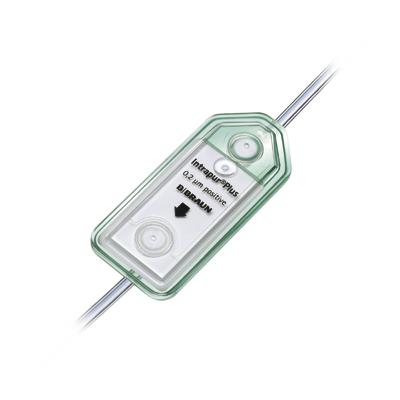
Os filtros em linha têm sido sugeridos para limitar a carga de partículas infundidas através de linhas venosas centrais e para prevenir a infusão de bactérias e endotoxinas.16
A filtragem em linha pode reduzir a incidência de complicações graves causadas pela contaminação por partículas em pacientes pediátricos e neonatais em estado crítico, como SIRS (síndrome da resposta inflamatória sistêmica), sepse, insuficiência circulatória, ARDS (síndrome da angústia respiratória aguda), trombose, insuficiência renal aguda e insuficiência hepática aguda.
A taxa global de complicações desses eventos graves foi reduzida em 10% (de 40,9% para 30,9%) quando foram utilizados filtros IV.17
*Aplica-se aos filtros Intrapur® do nosso portfólio
A padronização dos processos pode prevenir complicações graves na terapia intensiva e aumentar a segurança do paciente. Inclua o uso de filtros adequados no fluxo de trabalho regular da UTI pediátrica e neonatal para minimizar o risco de contaminação por partículas em seus pacientes pediátricos e neonatais.
Além da redução da morbidade em pacientes pediátricos, a redução da contaminação por partículas também diminui o tempo de internação e a duração da ventilação mecânica.17 Como resultado, os pacientes jovens podem receber alta mais cedo da UTI e voltar para casa, para suas famílias, mais rapidamente, para simplesmente crescer e ser crianças..
Pediatrics & Neonatology
1. Mehrkens HH, Klaus E, Schmitz JE. Possibilities of material contamination due to additional injections. Klin Anasthesiol Intensivther. 1977;14:106-13.
2. Walpot H, Franke RP, Burchard WG, Agternkamp C, Müller FG, Mittermayer C, Kalff G. Particulate contamination of infusion solutions and drug additives within the scope of long-term intensive therapy. 1. Energy dispersion electron images in the scanning electron microscope-REM/EDC. Anasthesist. 1989;38(10):544-8.
3. Werner BP, Winter G. (2015) Particle contamination of parenteralia and in-line filtration of proteinaceous drugs. Int J Pharm;496(2):250-67
4. Doessegger L, Mahler HC, Szczesny P, Rockstroh H, Kallmeyer G, Langenkamp A, Herrmann J, Famulare J. (2012) The potential clinical relevance of visible particles in parenteral drugs. J Pharm Sci; 101(8): 2635-44
5. Jack T. Micro Particles Contamination. Innocent Bystander or Real Threat? 2012 (Presentation: „_Micro Particles Contamination_Jack_MHH_2012“).
6. Boehne M, Jack T, Köditz H, Seidemann K, Schmidt F, Abura M, Bertram H, Sasse M. In-line filtration minimizes organ dysfunction: new aspects from a prospective, randomized, controlled trial. BMC Pediatr. 2013;13:21.
7. Puntis JW, Wilkins KM, Ball PA, Rushton DI, Booth IW. Hazards of parenteral treatment: do particles count? Arch Dis Child 1992 Dec;67(12):1475–7.
8. Breaux CW, Duke D, Georgeson KE, Mestre JR. Calcium phosphate crystal occlusion of central venous catheters used for total parenteral nutrition in infants and children: prevention and treatment. J Pediatr Surg 1987 Sep;22(9):829–32.
9. Bradley JS, Wassel RT, Lee L, Nambiar S. Intravenous ceftriaxone and calcium in the neonate: assessing the risk for cardiopulmonary adverse events. Pediatrics 2009 Apr;123(4):e609–13.
10. Monte SV, Prescott WA, Johnson KK, Kuhman L, Paladino JA. Safety of ceftriaxone sodium at extremes of age. Expert Opin Drug Saf 2008 Sep;7(5):515–23.
11. Perez M, Maiguy-Foinard A, Barthélémy C, Décaudin B, Odou P. Particulate Matter in Injectable Drugs: Evaluation of Risks to Patients. Pharmaceutical Technology in Hospital Pharmacy 2016;1(2):91-103.
12. Van Lingen RA, Baerts W, Marquering ACM, Rujis GJHM. The use of in-line filtration in sick newborn infants. Acta paediatrica 2004; 93:1-5.
13. Heyman S. Toxicity and safety factors associated with lung perfusion studies with radiolabeled particles. J Nucl Med Off Publ Soc Nucl Med 1979 Oct;20(10):1098–9.
14. Lofthus RM, Srebnik HH. The physical dimensions of the human neonatal cardiovascular system. J Biomech Eng 1987 Nov;109(4):336–9.
15. Bethune K Allwood M, Grainger C, Wormleighton C; British Pharmaceutical Nutrition Group Working Party. (2001) Use of filters during the preparation and administration of parenteral nutrition: position paper and guidelines prepared by a British pharmaceutical nutrition group working party. Nutrition;17(5):403-8.
16. Virlouvet AL, Pansiot J, Toumazi A et al. In-line filtration in very preterm neonates: a randomized controlled trial. Sci Rep 2020; 10(5003).
17. Jack T, Boehne M, Brent BE, Hoy L, Köditz H, Wessel A, Sasse M. In-line filtration reduces severe complications and length of stay on pediatric intensive care unit: a prospective, randomized, controlled trial. Intensive Care Med. 2012; 38:1008–1016.